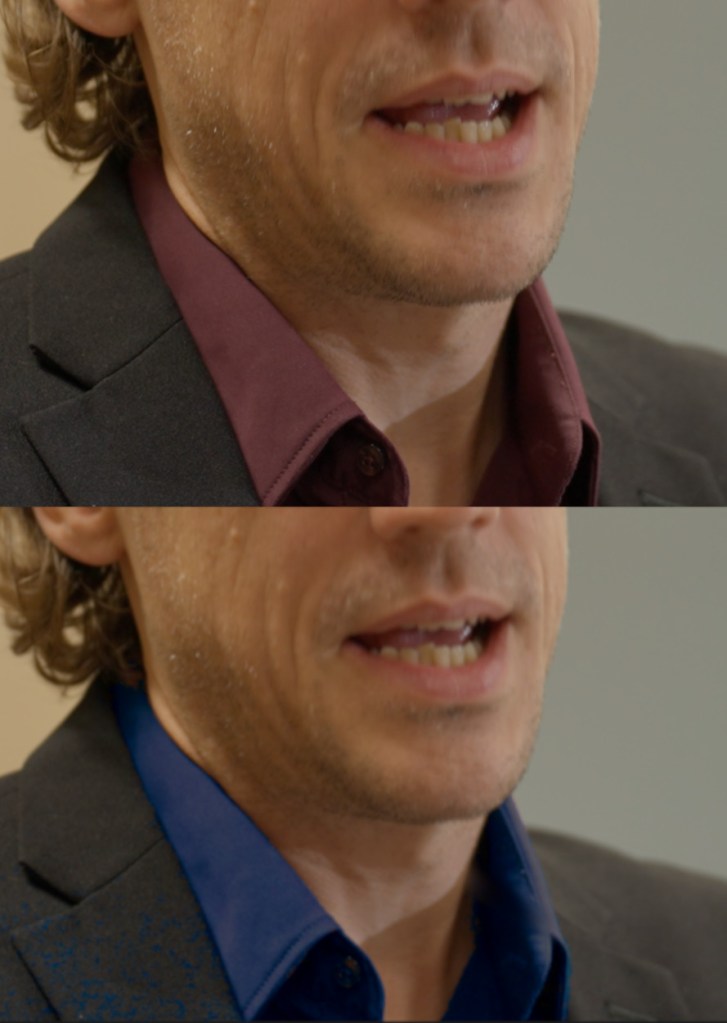
After showing a rough cut of Automatic (V3) to Angela and Carrie the other week, I came away with a stack of notes. I’ve been steadily working through them since then, tweaking what I can, and filling in a few gaps, including adding bits of media I’d somehow overlooked.
Last week was largely spent wandering around Brighton, grabbing shots of buildings at different times of the day to use as transitions. I also brought Keaton in for a pick-up shot, which we recreated in my spare room.
With the new material dropped in, we held a screening – and I found that things have come together rather well. The pick-up works and the transitions help the mood. I’m calling this V3.2.
On Saturday evening, we held a screening of V3.2 for a small group of seven civilians – friends who’d kindly volunteered to watch the film and offer feedback. We assembled around 7pm, opened a few beers and bottles of wine, and watched the film straight through – just over two hours in total. This was followed by a good hour and a half of discussion. It was generally positive once people settled in. The main issue was how long it took them to become engaged, so my next challenge is to tighten the first hour to make it sharper, punchier and possibly shorter.
Come Monday, I found myself printing around about 60 scraps of paper, each labelled with a scene title, and spread them across my dining room table. Some sequences are fixed in place, but others, I’m discovering, are more flexible than I’d thought, although I have to be careful about continuity. I did try moving one scene forward in V3.2, but Angela quite rightly pointed out that the guy was wearing the wrong shirt for that particular day. However, a bit of tinkering in Davinci Resolve revealed I can adjust shirt colours more easily than I’d realised – so all is not lost.
My current to-do list includes:
- Shorten and strengthen the first half
- Sort out a raft of smaller issues
- Shoot a few more pick-ups and transitions
We’re also considering whether an introductory sequence might better establish the mood – and then there’s the sound. It all needs a proper pass; none of it’s terrible, but the levels need balancing, and a bit of noise reduction and voice isolation won’t go amiss. After that, of course, comes colour grading.
There’s definitely much more to this film lark than meets the eye.
 Nigel Chaloner